



How to Create a Study Schedule That Actually Works: A Student's Complete Guide
Step-by-step system to plan your study time, beat procrastination, and consistently hit your academic goals
Discover step-by-step how to build a realistic study schedule using time blocking, energy mapping, and flexible planning to improve grades and reduce stress.
How to Create a Study Schedule That Actually Works: A Student's Complete Guide
Studies show that students who follow a structured weekly plan perform up to 40% better in exams than those who work randomly—yet less than 20% of students actually stick to their routine beyond the first week. The problem isn't making a plan; it's creating one that realistically fits your lifestyle, energy levels, and academic responsibilities. A successful study schedule should be flexible enough to adapt to unexpected events while keeping you consistently on track toward your goals.

This guide provides a comprehensive roadmap for mastering your academic workload. We will explore how to create a study schedule that balances your personal energy levels with strict deadlines. By following these proven strategies, you can transform your approach to learning while significantly reducing the stress associated with last-minute cramming.
This article serves as your ultimate resource for achieving consistent academic performance throughout the semester. You will learn how to prioritize tasks, organize your study sessions effectively, and manage your time with greater efficiency and confidence.
Key Takeaways
- Understand the psychological benefits of structured academic planning.
- Learn how to align your workload with your natural energy peaks for maximum productivity.
- Discover practical methods to avoid the common pitfalls of rigid time management.
- Master the art of balancing your personal life with demanding coursework.
- Build sustainable study habits that improve long-term retention and academic performance.
Why Most Study Schedules Fail and How to Avoid Common Pitfalls
Have you ever wondered why your best intentions to follow a study schedule often end in frustration? Many students struggle because they try to plan every waking hour without accounting for normal human limitations.
Learning how to make a study schedule involves much more than simply filling empty boxes on a calendar. It requires a realistic understanding of your available time, mental energy, priorities, and daily responsibilities. When your schedule reflects reality instead of perfection, it becomes much easier to maintain over the long term.
The Trap of Unrealistic Planning
One of the biggest mistakes students make is over-scheduling their day. When you attempt to fit eight hours of intense study into a single afternoon, you are unintentionally setting yourself up for mental exhaustion and burnout. Your brain needs regular breaks and downtime to process information, consolidate memories, and maintain long-term focus.
Another common issue with unrealistic planning is ignoring the unpredictable nature of everyday life. Unexpected errands, family responsibilities, social commitments, or even simple fatigue can quickly derail a perfectly planned schedule. If your timetable leaves no room for flexibility, it is likely to fall apart the moment something unexpected happens. A truly effective study schedule should always include buffer time for life's uncertainties.
💡 Study Tip
Avoid filling every hour of your day with study sessions. Leave short buffer periods between tasks to handle unexpected interruptions without disrupting your entire schedule.
The Danger of Rigid Routines
Rigid routines often fail because they ignore your body's natural energy fluctuations. For example, forcing yourself to study advanced calculus at 9:00 PM when your mind is already exhausted will rarely produce good results. Working against your biological rhythm reduces concentration, lowers motivation, and makes studying feel far more difficult than it needs to be.
Instead of forcing yourself into a fixed routine, focus on building a flexible study framework that adapts to your changing energy levels. By allowing room for adjustments throughout the week, you can remain productive without feeling restricted. Flexibility is one of the key ingredients of a study schedule that actually lasts.
⚠️ Common Mistake
Many students confuse discipline with rigidity. A disciplined schedule is consistent, while a rigid schedule refuses to adapt when circumstances change. Long-term success comes from consistency—not perfection.
| Common Pitfall | Resulting Impact | Recommended Fix |
|---|---|---|
| Over-scheduling | Mental exhaustion | Add buffer time between study sessions to prevent burnout. |
| Rigid timing | Loss of motivation | Use energy-based study blocks instead of following a fixed hourly schedule. |
| Ignoring breaks | Reduced retention | Apply the Pomodoro Technique to maintain focus and improve memory retention. |
| Zero flexibility | Total plan abandonment | Schedule a weekly review to adjust your study plan whenever necessary. |
✔️ Quick Summary
The most effective study schedules are not the ones that look perfect on paper—they are the ones you can realistically follow every week. Building flexibility, taking regular breaks, and planning around your natural energy levels will help you stay productive without experiencing burnout.
Assessing Your Time Availability Before You Start
Most students struggle because they plan for a version of their week that does not actually exist. You may feel like you have plenty of free hours, but your real schedule often tells a very different story.
Taking an honest inventory of your time is the most important step in creating a functional study plan.

Before you can effectively manage your workload, you must conduct a thorough audit of your existing commitments. This process helps you understand the true structure of your week, making it much easier to build a realistic student study planner that you can actually follow.
Auditing Your Current Weekly Commitments
Begin by mapping out your fixed commitments. These are the non-negotiable blocks in your weekly calendar, including class schedules, part-time jobs, extracurricular activities, appointments, and other recurring responsibilities.
Don't forget to include essential daily activities such as commuting, meal preparation, exercise, and adequate sleep. A realistic study schedule works around your life—not against it.
“Time is the most valuable coin in your life. You and you alone will determine how that coin will be spent.”
Once these fixed commitments are visible, you'll clearly identify the remaining free time throughout your week. This clarity is essential when learning how to plan study time effectively, helping you avoid overcommitting yourself and reducing the stress of an overloaded schedule.
💡 Productivity Tip
Treat your study schedule like a financial budget. Before assigning study hours, account for every unavoidable commitment. Whatever time remains is your realistic study budget.
Identifying Hidden Pockets of Study Time
After mapping your fixed commitments, examine the small gaps between your daily activities. These overlooked time windows can become surprisingly productive study sessions.
For example, a 30-minute break between classes, your daily commute, or a quiet hour before dinner can be used for reviewing notes, practicing flashcards, or revising key concepts. Although these sessions are short, they accumulate into valuable study time over the course of a week.
Using a student study planner helps you capture these hidden opportunities before they disappear. Effective time management isn't just about scheduling long study blocks—it's about making intentional use of every available hour.
✔️ Quick Summary
Before adding new study sessions to your calendar, identify where your time already goes. A successful schedule is built on your actual availability—not on unrealistic expectations.
Aligning Your Study Tasks with Peak Energy Hours
Building a truly effective study timetable for students requires more than simply choosing random hours to study. Not every study session is equally productive because your cognitive performance naturally fluctuates throughout the day.
By recognizing these natural energy patterns, you can stop fighting your biology and start working with it.

Determining Your Chronotype
Your chronotype refers to your body's natural tendency to sleep and wake at particular times of the day. Understanding your biological rhythm allows you to schedule study sessions when your brain performs at its highest level.
Most people generally fall into one of two categories:
- Morning Larks – People who feel most energetic and focused shortly after waking up.
- Night Owls – Individuals who experience their highest levels of concentration and creativity during the evening or late at night.
To identify your chronotype, pay attention to when you naturally feel the most alert without relying on caffeine or energy drinks. If mornings feel slow but your creativity peaks around midnight, you are most likely a night owl. Once you understand your natural rhythm, you can build a study timetable that protects your most productive hours instead of working against them.
💡 Study Tip
Don't copy someone else's study routine. The best schedule is the one that matches your own energy cycle, allowing you to study when your brain performs at its best.
Matching Subject Difficulty to Your Mental Clarity
Once you've identified your peak energy hours, reserve those periods for your most demanding academic work. Difficult subjects such as advanced mathematics, engineering, scientific theories, or essay writing require maximum concentration and analytical thinking.
If you attempt these challenging topics during your low-energy periods, you'll likely spend far more time struggling than actually learning. Matching subject difficulty with your mental clarity allows you to study more efficiently while reducing frustration and improving information retention.
Use the following guide to organize your study sessions according to your daily energy levels.
| Energy Level | Best Task Type | Example Activity |
|---|---|---|
| Peak | High Complexity | Writing essays, solving complex problems, or preparing for exams. |
| Moderate | Medium Complexity | Reviewing notes, reading textbooks, and revising class materials. |
| Low | Low Complexity | Organizing study materials, updating notes, or practicing light flashcard drills. |
✔️ Quick Summary
Your study schedule becomes far more effective when you match difficult subjects with your highest energy levels. Instead of forcing yourself to study challenging topics when you're mentally exhausted, align your workload with your natural rhythm to improve focus, retention, and productivity.
By aligning your most challenging work with your highest energy levels, you maximize knowledge retention while minimizing frustration. This strategic approach is one of the most important elements of a successful study timetable for students. Remember, consistency is essential—but working with your brain instead of against it is the real secret to long-term academic success.
✔️ Quick Summary
Study smarter—not harder. Reserve your peak energy hours for your most demanding subjects, and leave lighter tasks for periods when your concentration naturally declines.
How to Create a Study Schedule Using Time Blocking
One of the most effective ways to improve your productivity is by assigning specific tasks to dedicated blocks of time. Instead of constantly deciding what to study next, you simply follow the plan you've already created.
When you learn how to create a study schedule using the Time Blocking Method, you naturally eliminate the temptation to multitask—a habit that often reduces focus and productivity.
By giving every assignment its own space on your calendar, you protect your mental energy and ensure steady progress across all your subjects.

Time blocking is a cornerstone of effective time management for students who want to stay organized while avoiding burnout. Rather than staring at an overwhelming to-do list, your day becomes a series of clear, manageable study sessions with a defined purpose.
This structured approach reduces decision fatigue, helps you stay focused, and significantly lowers the anxiety that often accompanies a heavy academic workload.
💡 Study Tip
Treat every study block like an important appointment. During that time, eliminate distractions, silence notifications, and focus on completing just one task. Deep focus always outperforms multitasking.
The Fundamentals of Time Blocking
Getting started with time blocking is simple. Begin by identifying your highest-priority tasks and assigning each one to a dedicated time slot on your calendar. Treat these study blocks as non-negotiable appointments with yourself, just as you would a class or an important meeting.
For example, if you have a challenging chemistry assignment, reserve a 90-minute study block during your peak energy hours and commit to working without distractions until the session ends.
Keep your schedule realistic by allowing time for short breaks and transitions between activities. If a task takes longer than expected, don't become discouraged. Simply adjust your upcoming study blocks during your next weekly review. The goal is to build a routine that feels sustainable, flexible, and easy to maintain rather than overly restrictive.
💡 Productivity Tip
Don't schedule every minute of your day. Leave 10–15 minute buffer periods between study blocks to accommodate unexpected interruptions and prevent mental fatigue.
Integrating the Pomodoro Technique for Better Focus
Once your study blocks are in place, you can further improve your productivity by using the Pomodoro Technique. This proven time-management strategy alternates focused work sessions with short breaks, helping you maintain concentration without feeling mentally exhausted.
The traditional Pomodoro cycle consists of 25 minutes of focused study followed by a 5-minute break. After completing four consecutive sessions, reward yourself with a longer break of approximately 15–30 minutes.
For instance, if you've scheduled a two-hour history study block, divide it into four Pomodoro sessions. This approach gives your brain regular opportunities to recover while maintaining high levels of focus and productivity throughout the session.
⏱ Recommended Pomodoro Cycle
- 25 minutes — Deep, distraction-free study
- 5 minutes — Short break
- Repeat the cycle 4 times
- Take a 15–30 minute extended break
By combining time blocking with the Pomodoro Technique, you'll develop a study routine that improves concentration, reduces burnout, and supports your long-term academic goals. Together, these methods form one of the most effective systems for modern time management for students.
✔️ Quick Summary
Time blocking helps you decide when to study, while the Pomodoro Technique helps you decide how to stay focused. When used together, they create a highly effective study system that boosts productivity and reduces mental fatigue.
Prioritizing Your Subjects by Deadline and Complexity
Effective time management for students depends on more than simply studying harder—it requires studying smarter. As your academic workload grows, it becomes increasingly important to distinguish between urgent deadlines and long-term priorities.
Rather than treating every assignment as equally important, focus your energy on tasks that have the greatest academic impact. By refining your study timetable based on both deadlines and subject complexity, you'll make better decisions about where your time and effort should be invested.
The Eisenhower Matrix for Academic Tasks
The Eisenhower Matrix is a powerful decision-making framework that helps you organize academic responsibilities into four clear categories based on their urgency and importance. Instead of reacting to every assignment or notification, this method encourages you to focus your attention where it will have the greatest impact on your academic success.
By placing your tasks into this framework, you can stop reacting to every notification and start working with intention.

This simple prioritization strategy makes it easier to identify which assignments require immediate attention and which ones can be scheduled for later in the week. As a result, you'll spend less time feeling overwhelmed and more time making meaningful academic progress.
| Category | Recommended Action | Example |
|---|---|---|
| Urgent & Important | Do Immediately | Preparing for an exam scheduled tomorrow. |
| Not Urgent & Important | Schedule It | Working on a long-term research paper. |
| Urgent & Not Important | Delegate or Minimize | Constant group chat notifications. |
| Not Urgent & Not Important | Eliminate | Mindless social media scrolling. |
💡 Productivity Tip
Before starting your day, identify one task from the Urgent & Important category and complete it first. This simple habit helps build momentum and ensures your most valuable work gets done.
Managing Heavy Workloads During Exam Seasons
Exam periods often create intense pressure, making even well-organized students feel overwhelmed. Instead of trying to study everything at once, divide large subjects into smaller, manageable study sessions that fit within your peak energy hours.
Breaking complex topics into achievable milestones reduces mental fatigue, improves concentration, and helps you maintain steady progress throughout the week without burning out.
Remember that consistent daily effort is far more effective than last-minute cramming. When you schedule your most difficult subjects during periods of maximum mental clarity, you'll improve both retention and confidence before exams.
✔️ Exam Success Tip
Don't wait until exam week to review your notes. Short, consistent revision sessions throughout the semester are significantly more effective than marathon study sessions the night before an exam.
Building Flexibility and Buffer Time into Your Routine
Creating a resilient weekly study schedule requires more than simply filling every available hour with study sessions. If your plan is too rigid, even a single unexpected event can disrupt your entire routine.
Flexibility is not a sign of weakness; it is a strategic advantage that keeps you moving forward.

A flexible schedule allows you to adapt without feeling like you've failed. Instead of abandoning your study plan after one interruption, you simply adjust your remaining study blocks and continue making progress. This mindset makes your routine more sustainable and easier to maintain throughout the semester.
✔️ Quick Summary
Productive students don't follow perfect schedules—they follow flexible systems. The ability to adapt while staying consistent is one of the strongest predictors of long-term academic success.
Why You Need Margin for Error
A perfect study schedule may look impressive on paper, but in reality it often becomes a trap that leads to frustration and burnout whenever something unexpected happens. Instead of aiming for perfection, build buffer blocks into your weekly schedule. These flexible time slots act as a safety net, allowing you to catch up on unfinished work without feeling like you've failed.
Adding buffer time ensures that your weekly study schedule remains effective even when life doesn't go exactly according to plan. Rather than abandoning your routine after one missed session, you'll have dedicated time to recover and continue making progress.
"It is not the strongest of the species that survives, nor the most intelligent, but the one most responsive to change."
Think of these buffer periods as "reset buttons" for your week. If you fall behind on a reading assignment, project, or revision session, your reserved buffer time allows you to recover before small delays turn into major setbacks. This simple strategy prevents the domino effect where one missed task disrupts your entire study routine.
💡 Study Tip
Reserve at least one flexible study block every week. If nothing unexpected happens, use it for revision, practice tests, or getting ahead on future assignments.
Handling Unexpected Events Without Breaking Your Flow
Unexpected situations are unavoidable, but they don't have to derail your academic progress. When an emergency or schedule change occurs, focus first on your highest-priority tasks and move everything else into your pre-planned buffer blocks.
This flexible approach allows your study schedule to adapt without creating unnecessary stress. Instead of starting over each time something changes, you simply reorganize your remaining study sessions and continue moving forward.
| Feature | Rigid Schedule | Flexible Schedule |
|---|---|---|
| Response to Crisis | Causes total collapse | Allows quick adjustment |
| Burnout Risk | High | Low |
| Buffer Time | None | Built-in |
| Long-term Success | Unlikely | Highly Probable |
Ultimately, maintaining a successful weekly study schedule is about consistency—not perfection. By preparing for the unexpected, you develop the resilience needed to stay productive throughout your academic journey. Stay adaptable, trust your system, and allow your schedule to become a tool for growth rather than a source of unnecessary stress.
✔️ Quick Summary
The strongest study schedules aren't the most rigid—they're the most adaptable. Building flexibility into your routine allows you to recover quickly from setbacks while maintaining long-term consistency.
Structuring Your Weekly and Daily Study Routine
A well-structured routine is one of the most powerful tools successful students use to stay ahead of deadlines and reduce academic stress. Learning how to create a study schedule that fits your lifestyle is the first step toward building lasting study habits.
By creating a consistent daily study routine, you eliminate the stress of deciding what to study every time you sit down at your desk.

The Anatomy of a Productive Daily Routine
A productive day follows a natural progression—from planning and preparation to focused study sessions and finally reflection. Begin each morning by reviewing your daily goals so your brain starts the day with clear priorities instead of reacting to distractions.
During your peak energy hours, tackle the subjects that demand the highest concentration. As your energy begins to decline later in the day, switch to lighter activities such as organizing notes, reviewing flashcards, or preparing materials for tomorrow's classes.
Following this rhythm allows you to stay productive without exhausting yourself, creating a sustainable study routine that supports consistent academic improvement.
💡 Daily Routine Tip
End every study day by planning tomorrow's top three priorities. This simple habit reduces decision fatigue and makes it easier to begin studying the next day.
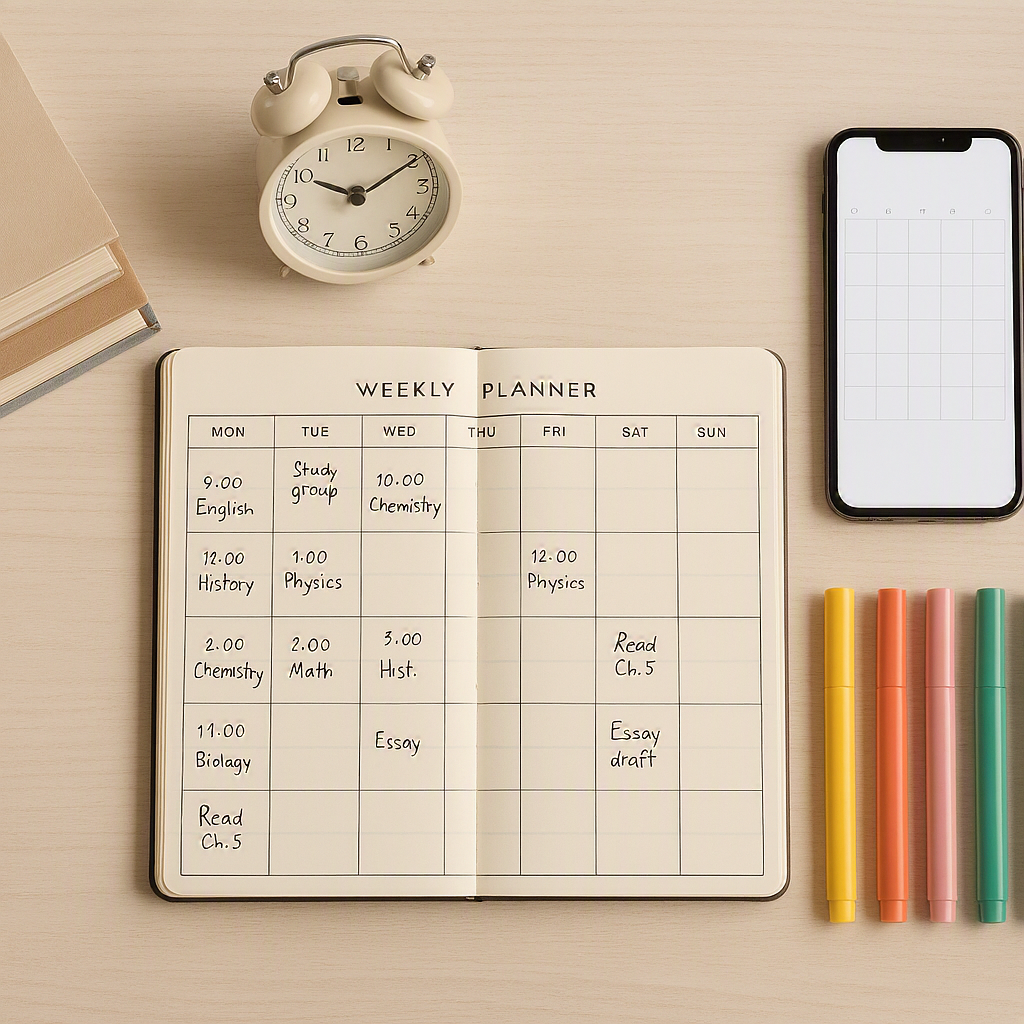
Sample Weekly Study Schedule Template
To effectively monitor your academic progress, you need a reliable study schedule template that covers your entire week. A clear visual structure helps you understand exactly where your time is being spent while ensuring that every subject receives the attention it deserves.
The following framework can be customized to fit your class schedule, extracurricular activities, work commitments, and personal responsibilities.
| Time Block | Focus Area | Activity Type |
|---|---|---|
| Morning | High-Focus Tasks | Deep study sessions, problem-solving, and difficult assignments. |
| Afternoon | Collaborative Work | Group projects, revision sessions, and classroom review. |
| Evening | Planning & Review | Organizing notes, reviewing key concepts, and preparing for the next day. |
Maintaining a weekly study schedule becomes much easier when you have a clear visual roadmap. Use your student study planner to record these study blocks and monitor how much time you actually dedicate to each subject throughout the week.
If a particular study block repeatedly feels unproductive, don't hesitate to move it to a different time of day that better matches your natural energy levels. Remember, your schedule should work for you—not the other way around.
Consistency is the foundation of long-term academic success. By following a structured yet flexible routine, you'll notice increased productivity, improved retention, and significantly lower stress levels over time.
✔️ Weekly Planning Tip
At the beginning of each week, schedule your most challenging subjects first. Once your highest-priority work is secured, fill the remaining study blocks with revision, practice, and lighter learning activities.
Reviewing and Adjusting Your Plan for Long-Term Success
Learning how to plan study time is not a one-time task—it's an ongoing process of evaluation and improvement. Even the most carefully designed study schedule needs regular adjustments as your semester progresses and your priorities change.
By treating your schedule as a living document, you ensure that your study habits continue to support your academic goals instead of becoming outdated or ineffective.

💡 Success Mindset
Your study schedule should evolve with your workload. Regular reviews help you identify what is working, eliminate ineffective habits, and continuously improve your productivity.
The Weekly Reflection Process
Set aside just 15 minutes every Sunday to review your academic progress. Reflect on which study sessions felt productive and which tasks consistently challenged your focus. This simple habit is one of the most effective study schedule tips for students who want to improve both their productivity and grades.
Write down what worked well throughout the week. Did your morning study sessions produce better results than late-night revision? Were your time blocks realistic? Did you complete your highest-priority assignments? Use these observations to fine-tune your schedule for the upcoming week so every study session becomes more effective than the last.
💡 Weekly Review Checklist
- ✔ Review completed tasks.
- ✔ Identify unfinished assignments.
- ✔ Adjust study blocks if needed.
- ✔ Plan your three highest priorities for next week.
- ✔ Remove distractions that reduced productivity.
When to Pivot Your Strategy
Sometimes, even the best study plan needs to change. If you consistently miss deadlines, lose motivation, or feel overwhelmed, it's a clear sign that your current routine no longer supports your academic needs.
Don't hesitate to experiment with different study techniques, adjust your time blocks, or reorganize your priorities. Recognizing when to change your strategy demonstrates academic maturity rather than failure.
By applying these effective study schedule tips and remaining flexible, you'll develop a system that evolves alongside your coursework and continues supporting your long-term academic success.
✔ Remember
Your study schedule is a living system—not a fixed set of rules. Review it regularly, improve it continuously, and allow it to grow with your academic journey.
Conclusion
Building a study schedule that truly works is a journey of continuous improvement, self-awareness, and consistency. The strategies you've learned throughout this guide will help you replace stress and last-minute cramming with confidence, organization, and sustainable academic habits.
You now possess the tools to transform your habits and reach your goals with less stress.

True academic success isn't built overnight—it's the result of small, intentional choices repeated every day. Protect your time, prioritize your most important work, and remain flexible enough to adapt whenever circumstances change.
Whether you're preparing for exams, balancing multiple courses, or simply trying to become more organized, the right study schedule can dramatically improve your productivity and reduce unnecessary stress.
Ready to Study Smarter?
At Edufluxa, we believe every student deserves a study plan that matches their goals, learning style, and schedule. Our expert tutors and specialized courses help students build personalized learning strategies that lead to better academic performance and long-term success.
Take control of your academic future today and start building study habits that deliver lasting results.
Frequently Asked Questions (FAQs)
1. How do I start creating a study schedule that I can actually follow?
Begin with a time audit. List your fixed commitments—such as classes, work, meals, commuting, and sleep—before scheduling study sessions. This prevents overplanning and helps you create a realistic routine that you can maintain consistently.
2. What is the best way to organize a weekly study schedule?
The most effective approach is time blocking. Assign specific subjects to dedicated study sessions instead of relying on a simple to-do list. Combining time blocking with a weekly planner ensures every subject receives sufficient attention.
3. How can I stop procrastinating while studying?
Use the Pomodoro Technique by studying for 25 minutes followed by a 5-minute break. Pair this with studying your most difficult subjects during your peak energy hours to maximize concentration and reduce procrastination.
4. How should I prioritize assignments during busy weeks?
Use the Eisenhower Matrix to separate urgent tasks from important long-term projects. Completing high-priority work first ensures steady progress while reducing unnecessary stress during exam periods.
5. Why is time management so difficult for students?
Many students create schedules that are too rigid to handle real life. Building flexibility into your routine with buffer blocks allows you to recover from unexpected events without abandoning your entire study plan.
✔ Final Key Takeaways
- Create a realistic study schedule based on your actual availability.
- Study challenging subjects during your peak energy hours.
- Use time blocking together with the Pomodoro Technique.
- Prioritize assignments using the Eisenhower Matrix.
- Include buffer time to handle unexpected events.
- Review and improve your schedule every week.
- Focus on consistency instead of perfection.
Ready to Build a Study Schedule That Actually Works?
Creating an effective study schedule is the first step toward better grades, improved productivity, and less academic stress. The real challenge is staying consistent—and you don't have to do it alone.
At Edufluxa, our expert tutors and personalized learning programs help students develop smarter study strategies, strengthen weak subjects, and achieve their academic goals with confidence.
Whether you're preparing for exams, improving your time management skills, or looking for one-on-one academic support, we're here to help you succeed.
Explore Edufluxa Courses →

Admin
More from Admin
Time Management Strategies for ...
30 Jun 2026
Comments
Want new courses and tutor updates in your inbox?


Reply to Comment